skip to content
Current Lead Times: Rider-Ready Framesets: 4 weeks. Full Custom Bikes: 7 weeks.

Building Your Titanium and Carbon-Titanium Bikes in the USA for 29 Years

Articles  ›  Titanium

Titanium Anodization Fatigue Problems

Anodization of titanium degrades its fatigue strength and service live. There is no way around these problems.

TL;DR

Anodizing cut the fatigue strength of Ti-6Al-4V titanium by about 14%. Base-metal bars survived 10 million cycles at 950 MPa. Anodized bars survived that long only after the stress dropped to about 815 MPa.

Author   •   Rob Vandermark
Reading Time   •   5 min read
Category   •   Engineering
Topics   •   Titanium, Anodization,
Fatigue Strength

The academic article Evaluation of shot peening on the fatigue strength of anodized Ti-6Al-4V alloy from the Materials Research journal provides useful analysis of a fundamental problem with anodizing titanium. The researchers conclude that "A significant reduction in the fatigue strength of anodized Ti-6Al-4V was observed." Costa, M.Y.P., Voorwald, H.J.C., Pigatin, W.L., Guimarães, V.A. & Cioffi, M.O.H. (2006). "Evaluation of shot peening on the fatigue strength of anodized Ti-6Al-4V alloy". Materials Research 9(1):107-109.

Their research presents the same data we see in every fatigue test for anodized fatigue. Poor results. It's important that titanium bike buyers make informed decisions about the tradeoffs of anodization.

Anodization makes titanium parts fail sooner because the anodized surface is harder and more brittle than the base titanium. The brittle surface cracks and then propagates through the base titanium.

“These results indicate a severe decrease in fatigue strength for the anodized conditions…”

— Costa et al., Evaluation of shot peening on the fatigue strength of anodized Ti-6Al-4V alloy. Materials Research, 2006 Costa, M.Y.P., Voorwald, H.J.C., Pigatin, W.L., Guimarães, V.A. & Cioffi, M.O.H. (2006). "Evaluation of shot peening on the fatigue strength of anodized Ti-6Al-4V alloy". Materials Research 9(1):107-109.
Animation: Ano-Tester  |  In one series of tests, at 825 MPa load, the anodized pieces failed in 0.6% of the targeted 107 cycles. The non-anodized samples exceeded the target. Animation created by Seven Cycles. Data sourced from primary referenced article.
Examples of Seven's in-house anodization.  Lots of testing.  No means of maintaining fatigue life.
Examples of Seven's in-house anodization. Lots of testing. No means of maintaining fatigue life.
Seven's beautiful colors in pristine lab condition.  Flat and muddy once it's been touched or ridden outside for a few hours.
Seven's beautiful colors in pristine lab condition. Flat and muddy once it's been touched or ridden outside for a few hours. No way around this issue.
Seven has produced so many designs with so little upside after the first few rides.  Reduced fatigue strength and dull colors.
Seven has produced so many designs with so little upside after the first few rides. Reduced fatigue strength and dull colors.

Why would someone anodized titanium?

Anodizing creates an oxide layer on titanium by running electric current through the part in an acid bath. Aerospace uses it to protect against corrosion and surface wear. In the bike industry, it is used mostly for color.

The reason some aerospace applications benefit from this oxide layer is the very reason tha anodization reduces fatigue strength. The oxide layer is harder and more brittle. Under cyclic loading, that brittle surface cracks much faster than a non-oxide titanium surface.
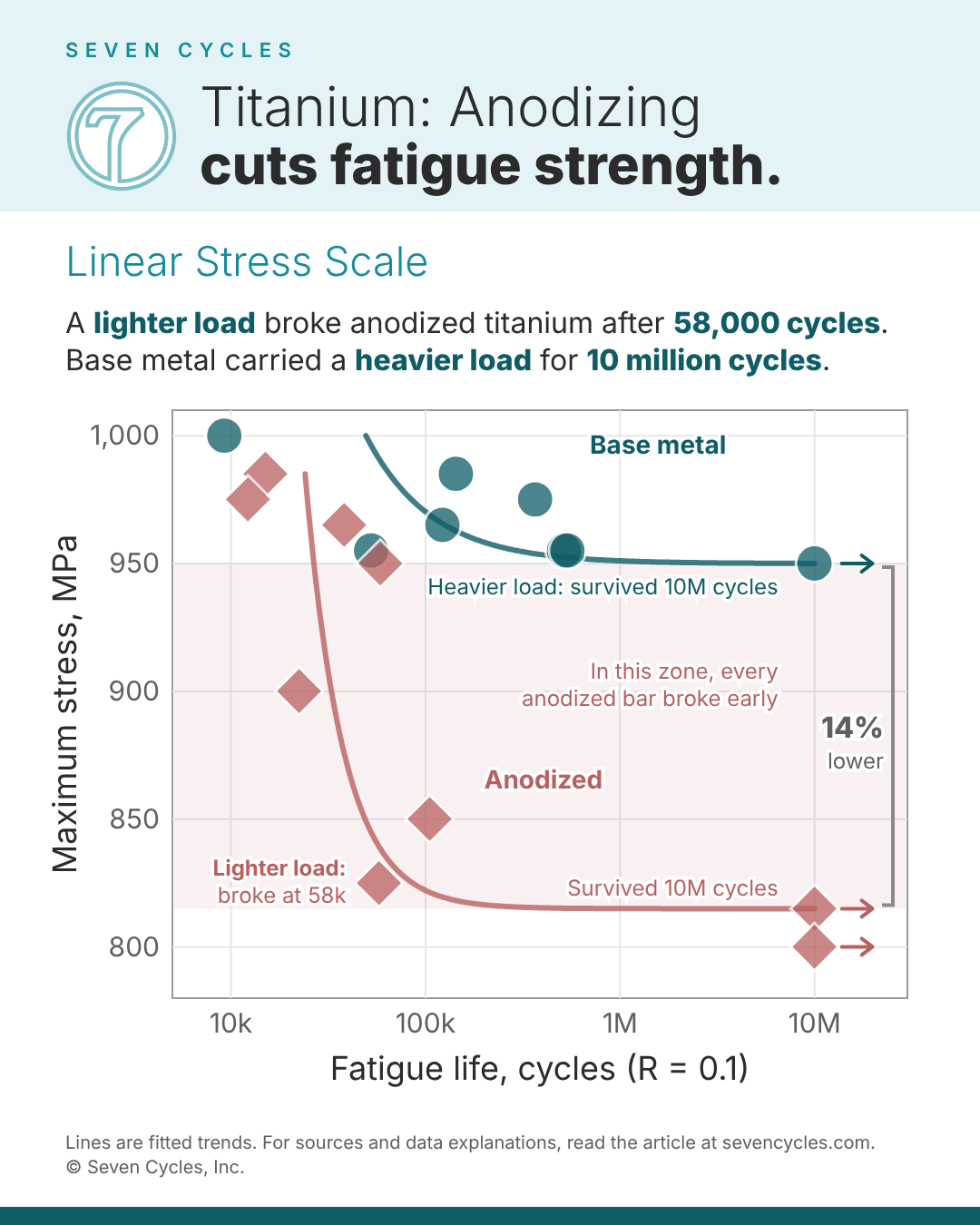
Animation: Ano-Failure  |  Anodized parts fail sooner at any given cyclic stress. Anodized parts can only pass standard high-cycle fatigue tests at much lower stress levels. Chart redrawn by Seven Cycles from primary referenced article data. Shot-peened results omitted.
xxxxxxxxxxxxxxxxx
Figure: Log  |  Anodizing results in a 14% reduction in fatigue strength. Why take this risk? Chart redrawn by Seven Cycles from primary referenced article data. Shot-peened results omitted.

What the data show

Anodizing lowered titanium's stress survival for 10 million cycles from 950 MPa to about 815 MPa. That is a drop of about 14%. Anodized titanium survived 10 million cycles at 815 and 800 MPa. Every bar tested at 825 MPa or above broke, all within 105,000 cycles.

Stress is how hard the test sample is pulled. Cycles are the number of times. A raw un-anodized coupon was stressed at 950 MPa for 10 million cycles and never broke. An anodized coupon, stressed 13% less hard, at 825 MPa, broke after 58,000 pulls. That is less than 1% of the way to 10 million.

Anodizing also degraded material life at high stress. For example, at 985 MPa, a raw un-anodized test piece lasted 143,328 cycles and an anodized coupon lasted 15,034, about one-tenth as long.

Why it matters for framebuilding

A bike frame sees millions of load cycles: every pedal stroke, every vibration, every acceleration. Material fatigue is the most common failure for bike frames.

Fatigue cracks usually start at the surface. Anodizing changes the surface. In this study, that change lowered the stress titanium could carry for 10 million cycles by about 14%. The finish on a titanium frame is a structural choice, not only a cosmetic one. Color, for most riders, is not worth a shorter service life.

Notes

These are lab tests, not bike tests. The bars were pulled at 800-1,000 MPa, about two-thirds to four-fifths of the alloy's ultimate strength. A frame's working stresses are far lower. Riding loads also vary in size and direction instead of repeating one steady pull. So the cycle counts and test times here are not riding hours or a prediction of frame life. What carries over is the comparison: two surfaces, tested under identical conditions, with very different results.

Test conditions: Axial loading, R = 0.1. R = 0.1 testing is favorable to anodizing but does not mimic the cyclic loading seen in bike riding. R = -1 is the kind of stress that bike frames undergo. The data, as seen in other academic articles, shows a fatigue strength reduction for R = -1 ranging of 5% to 38%, because it is a harsher test. T. Ludian and L. Wagner. (2008). "Mechanical Surface Treatments for Improving Fatigue Behavior in Titanium Alloys". Advances in Materials Science, Volume 8 (2008): Issue 2, Figure 9 a and b.

Footnotes